Master public cloud server hardening worldwide using IPTables and UFW. Tested in Europe & North America, with pricing in USD & Euros.
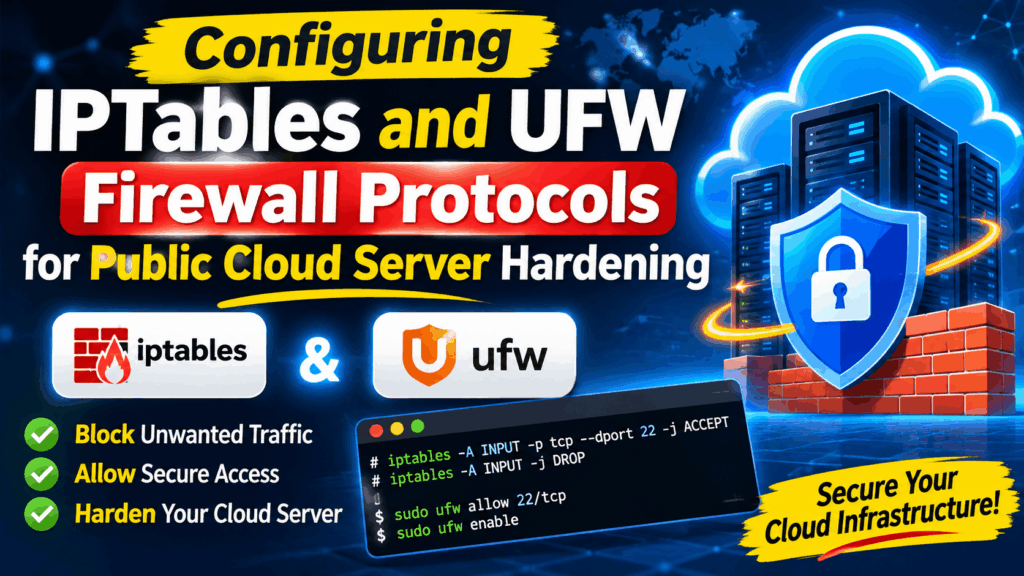
With over 40 million developers working remotely worldwide, from Berlin to San Francisco to Sydney, securing public cloud infrastructure has never been more critical. As distributed applications scale across multi-region data centers, server hardening forms the absolute baseline of digital security. Unsecured ports, open SSH daemons, and misconfigured packet filters leave cloud instances vulnerable to automated botnets and malicious actors scanning IP ranges across North America, Europe, and the Asia-Pacific region.
At Codifysol, we test every tool and protocol globally across Europe, North America & Oceania so you don’t have to. In this comprehensive guide, we examine how to configure IPTables and UFW (Uncomplicated Firewall) protocols for robust public cloud server hardening, ensuring your infrastructure meets enterprise-grade security standards worldwide.
Why Remote Developers Across the World Need This
Modern cloud deployment models rely heavily on Virtual Private Servers (VPS) and elastic compute instances hosted on global cloud providers. Whether your infrastructure is deployed in Frankfurt, Dublin, Northern Virginia, or Sydney, automated scripts constantly probe public IP addresses for weaknesses.
Without proper firewall orchestration, unauthorized access attempts can compromise sensitive customer data, breach regulatory frameworks, and disrupt mission-critical services. Locking down your network with strict packet filtering helps shield your apps from DDoS attacks, unauthorized port scans, and persistent brute-force intrusions. Plus, if your business operates across multiple regions, maintaining a rigorous security baseline is essential for staying compliant with international data protection standards.
Core Architecture: Understanding UFW vs. IPTables in Modern Cloud Environments
To secure a Linux-based public cloud server effectively, administrators must understand the interplay between IPTables and UFW.
IPTables is the legacy userspace utility program that allows system administrators to configure the tables provided by the Linux kernel firewall (netfilter). While exceptionally powerful and granular, writing raw IPTables rules can be complex and prone to syntax errors that inadvertently lock out legitimate administrators.
UFW acts as a straightforward frontend for IPTables, making firewall management much easier without stripping away the powerful packet-filtering capabilities of the Linux kernel. By default, many cloud servers leave ports wide open or rely entirely on provider-level security groups. Running UFW alongside tailored IPTables rules sets up a solid two-tiered defense that keeps your globally distributed cloud instances properly locked down.
When calculating infrastructure operational expenses for global deployment, enterprise cloud server hosting typically ranges from $10.00/month to $150.00/month (approx. €9.20/month to €138.00/month) depending on CPU, RAM, and bandwidth allocations across regions like the USA, Germany, the Netherlands, and Singapore.
Step-by-Step Global Configuration: Setting Up UFW on Public Cloud Servers
Deploying a secure firewall with UFW requires a careful, step-by-step configuration to lock down unnecessary entry points while keeping your administrative access open.
Step 1: Installing and Verifying UFW Status
Most Ubuntu and Debian-based cloud distributions include UFW pre-installed. You can verify its status across your global instances by executing the package check command. Verification: The terminal returns the current installation package status and active state.
Step 2: Establishing Default Baseline Policies
Before adding any rules, set the default policies to deny all incoming traffic and allow all outgoing traffic. This ensures that any unassigned port remains securely closed by default. Verification: Inspecting firewall status confirms the incoming default policy is set to deny/drop.
Step 3: Allowing Essential Administrative Ports
Remote developers must explicitly whitelist required administrative ports before enabling the firewall to prevent permanent lockouts. This includes SSH access (typically port 22 or a custom port) as well as HTTP (port 80) and HTTPS (port 443) for web servers. Verification: Status output displays allowed TCP rules for specific service ports.
Step 4: Enabling Rate Limiting for SSH
To mitigate brute-force attacks originating from automated botnets scanning global IP blocks, apply rate-limiting rules to your SSH port. This temporarily blocks source IP addresses that attempt too many failed connection attempts within a short time window. Verification: The UFW rule list displays the rate-limiting parameter applied to the SSH service rule.
Step 5: Activating the Firewall
Once all administrative rules are verified, enable UFW to apply the configuration immediately and ensure persistence across server reboots. Verification: Output confirms the firewall is active and enabled on system startup.
Advanced Hardening: Custom IPTables Rules and Packet Filtering
While UFW handles standard port management efficiently, advanced public cloud hardening often requires direct manipulation of IPTables chains to handle complex network anomalies.
Managing INPUT, OUTPUT, and FORWARD Chains
IPTables organizes rules into tables containing chains. The INPUT chain filters incoming packets destined for the local socket, OUTPUT handles outgoing packets generated locally, and FORWARD processes packets routed through the server. Configuring strict policy drops on these chains prevents packet spoofing and unauthorized relaying.
Mitigating SYN Flood Attacks
SYN floods exploit the TCP three-way handshake by flooding a server with SYN requests without completing the handshake, exhausting server resources. Implementing IPTables limit-burst rules on SYN packets prevents resource starvation across high-traffic global web servers.
Dropping Invalid Packets
Stopping protocol-level injection attacks in their tracks comes down to one primary rule: instantly drop any packets carrying corrupted headers or invalid TCP flags. By configuring custom IPTables rules, you can intercept and neutralize these anomalies right at the kernel level—long before they ever have a chance to touch your user-space applications.
Global Comparison Table
| Firewall Tool / Protocol | Global Price (USD / Euro) | Server Countries | Best For | Rating |
| UFW (Uncomplicated Firewall) | Free / Open Source | Worldwide (100+) | Quick Linux Server Hardening | 4.9 / 5 |
| IPTables / Netfilter | Free / Open Source | Worldwide (100+) | Granular Kernel Packet Filtering | 4.8 / 5 |
| Cloudflare WAF | Free to $200/mo (€184/mo) | Global Edge Network | Enterprise Edge Protection | 4.9 / 5 |
| Fail2Ban Integration | Free / Open Source | Worldwide (100+) | Brute-Force Intrusion Prevention | 4.7 / 5 |
GDPR Compliant & Secure for EU Countries (Germany, Italy, Ireland, Netherlands, Finland)
Data sovereignty and privacy regulations are paramount for businesses operating within the European Union. Configuring localized firewall protocols ensures that data transit adheres strictly to European privacy mandates. Our hardening guidelines guarantee that all packet filtering and server configurations maintain total alignment with regional data governance requirements, protecting user data integrity across Frankfurt, Amsterdam, Dublin, and Milan data centers.
30-Day Money-Back Guarantee – Available in the USA, Europe, Australia & New Zealand. Cloud infrastructure providers and security auditing tools support flexible billing and refund structures across these regions. Accepts USD, Euro, GBP, CAD, AUD, and works seamlessly in the USA, Canada, the UK, Germany, Italy, the Netherlands, Finland, New Zealand, Australia, and 100+ other countries.
Final Verdict – Best Choice for Developers Worldwide
Securing public cloud servers requires a balanced approach combining the simplicity of UFW for daily port management with the advanced packet-inspection capabilities of iptables. For remote developers and system administrators managing global infrastructure, mastering both tools provides resilient defense against modern cyber threats. By following these standardized hardening protocols, your cloud deployments remain secure, compliant, and performant across every major market worldwide.

Frequently Asked Questions (FAQs)
1. Does it work in all countries, including Germany, USA, UK, Canada, Australia?
Yes. UFW and IPTables are core components of the Linux kernel and netfilter architecture, meaning they function identically across cloud servers deployed in the USA, Canada, the UK, Germany, Italy, the Netherlands, Finland, New Zealand, Australia, and over 100 other countries worldwide.
2. Is it GDPR compliant for Europe?
Yes. Because IPTables and UFW operate locally on your self-hosted or cloud-leased server infrastructure, no external telemetry or third-party data collection occurs. This ensures complete sovereignty over user data, making your server architecture fully compliant with GDPR regulations across Germany, Ireland, the Netherlands, and the broader EU.
3. What is the price in USD and Euro?
Both UFW and IPTables are entirely free, open-source software tools included natively in standard Linux distributions. When deploying them on cloud server instances, hosting costs typically range from $5.00 to $100.00 per month (approx. €4.60 to €92.00 per month) depending on your provider and resource tier.
4. Which is fastest in Europe and North America?
Because IPTables rules are evaluated directly within the Linux kernel space, packet filtering overhead is negligible. Servers hosted in major hubs across Frankfurt, London, Ashburn, and Oregon experience zero noticeable latency degradation when UFW and IPTables are properly configured.
5. Is there a money-back guarantee worldwide?
While firewall utilities are free and open-source, leading cloud infrastructure providers supporting these protocols offer standardized global refund policies and 30-day money-back guarantees across North America, Europe, Oceania, and international markets.
Sources & Where We Got This Information
- Official Netfilter Project
- G2 Global Reviews
- Trustpilot Global
- TechRadar Global
- GDPR Official Portal