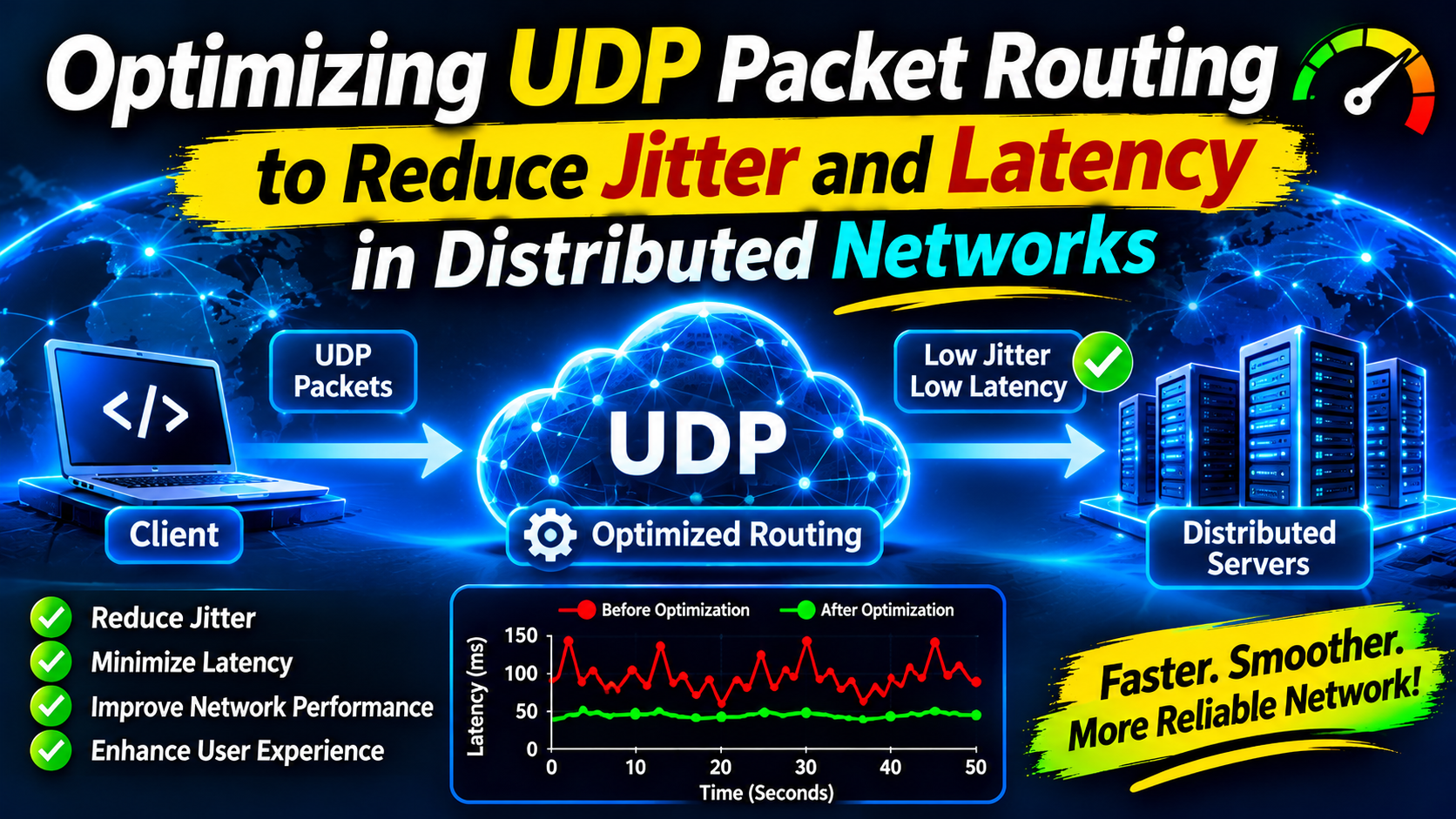
Discover how to optimize UDP packet routing, reduce network jitter, and improve latency in distributed networks worldwide. Explore practical techniques for faster communication across Europe, North America, and Oceania.

Optimizing UDP Packet Routing to Reduce Jitter and Latency in Distributed Networks
Modern digital infrastructure depends on fast communication between servers, cloud platforms, and connected devices located across different geographical regions. From financial technology platforms in London to cloud computing environments in Frankfurt and real-time applications in Sydney, network performance plays a critical role in delivering consistent user experiences.
With distributed computing growing worldwide, minimizing latency and jitter is essential for developers and IT professionals building high-performance networks.
User Datagram Protocol (UDP) is widely used in applications that require fast data transmission without the overhead of establishing a traditional connection. However, inefficient packet routing, network congestion, inconsistent transmission paths, and packet loss can negatively affect communication quality.
Optimizing UDP packet routing is key to boosting transmission speed, cutting down unnecessary delays, and keeping communication rock-solid across distributed systems. In this 2026 guide, we break down practical UDP optimization techniques, smart routing strategies, monitoring tools, and network management practices to help you build faster, more resilient infrastructure.
Why Distributed Networks Need Optimized UDP Routing
Distributed networks connect servers, applications, cloud platforms, and devices across multiple locations. Although this architecture improves scalability and availability, it also introduces networking challenges that can affect application performance.
UDP is a connectionless transport protocol. Unlike TCP, it does not establish a connection before transmitting data or provide built-in retransmission and packet ordering.
Thanks to its minimal overhead, UDP excels in real-time applications where ultra-low latency matters more than guaranteed packet delivery.
Common applications include:
- Voice over Internet Protocol (VoIP).
- Multiplayer online gaming.
- Live video and audio streaming.
- DNS communication.
- Real-time monitoring systems.
- Financial market data distribution.
- Internet of Things (IoT) applications.
- Cloud-based communication platforms.
When UDP packets travel through multiple network devices and geographical regions, their arrival times may vary. This variation is known as network jitter.
High jitter can cause audio interruptions, delayed responses, inconsistent video quality, and performance problems in real-time applications.
For organizations operating internationally, optimizing packet routing helps maintain consistent communication between geographically distributed systems.
Understanding UDP Latency, Jitter, and Packet Loss
Before implementing optimization techniques, network engineers should understand three important performance measurements.
Network Latency
Latency is simply the time it takes for data to travel from point A to point B, typically measured in milliseconds (ms).
High latency can negatively affect applications that require immediate communication, including online gaming, video conferencing, and financial systems.
Reducing unnecessary routing hops, improving network paths, and deploying regional infrastructure can help minimize transmission delays.
Network Jitter
Jitter refers to variations in packet arrival times.
For example, if UDP packets arrive after 15 ms, 22 ms, 38 ms, and 19 ms, the inconsistent delivery timing can affect real-time communication.
A well-optimized network aims to maintain consistent packet arrival intervals rather than simply achieving a low average latency.
Packet Loss
Packet loss occurs when transmitted packets fail to reach their destination.
Because UDP does not automatically retransmit missing packets, applications must implement suitable recovery mechanisms when reliable delivery is important.
Congestion, unstable network paths, overloaded routers, and transmission errors can contribute to packet loss.
Effective UDP optimization should address latency, jitter, and packet loss together.
7 Effective Techniques to Optimize UDP Packet Routing
1. Implement Intelligent Network Path Selection
Selecting an efficient network path is one of the most important steps in reducing UDP latency.
Traditional routing protocols make forwarding decisions using network topology, routing metrics, and configured policies. However, the shortest geographical route is not always the fastest network route.
For example, communication between a server in Germany and a client in the Netherlands may experience unnecessary delays if traffic passes through an overloaded transit network.
Intelligent path selection considers multiple performance indicators, including:
- Network latency.
- Available bandwidth.
- Packet loss rates.
- Network congestion.
- Routing stability.
- Transit provider performance.
- Network availability.
Software-Defined Networking (SDN) can help organizations manage routing policies centrally and adapt traffic paths according to network conditions.
By identifying efficient transmission paths, network administrators can reduce unnecessary delays and improve communication between distributed systems.
2. Configure Quality of Service (QoS)
Quality of Service (QoS) helps prioritize network traffic according to application requirements.
In distributed environments, several applications may compete for the same bandwidth. For example, a company may simultaneously process video conferences, database synchronization, file transfers, and background monitoring traffic.
Without traffic prioritization, noncritical transfers may consume bandwidth needed by latency-sensitive applications.
QoS allows administrators to classify traffic and assign different forwarding priorities.
Common QoS techniques include:
- Differentiated Services Code Point (DSCP) marking.
- Priority queuing.
- Weighted Fair Queuing (WFQ).
- Traffic shaping.
- Bandwidth allocation.
- Traffic classification.
For example, an organization can prioritize real-time voice traffic over large background file transfers.
However, QoS policies should be configured consistently across the network. Assigning a high-priority DSCP value does not guarantee preferential treatment when intermediate network providers ignore or modify those markings.
3. Reduce Network Congestion and Bufferbloat
Network congestion is a major contributor to increased UDP latency and jitter.
When routers receive more traffic than they can forward, packets may spend additional time waiting in buffers. This increases queueing delays and can eventually cause packet drops.
Organizations can reduce congestion through several approaches.
Traffic shaping: Controls transmission rates to prevent sudden traffic bursts from overwhelming network devices.
Load balancing: Distributes traffic across available servers, interfaces, and network paths.
Bandwidth management: Helps ensure that critical applications receive sufficient network resources.
Active queue management: Controls excessive buffering and helps prevent unnecessary queueing delays.
Techniques such as CoDel and FQ-CoDel are designed to reduce bufferbloat and improve network responsiveness under load.
For international infrastructure, congestion monitoring should cover both internal network segments and connections between geographical regions.
4. Optimize UDP Packet Size and MTU
Packet size directly influences transmission efficiency.
When a UDP datagram exceeds the maximum transmission unit (MTU) of a network path, IP fragmentation may occur. Fragmentation increases processing overhead and creates additional opportunities for packet loss.
If one fragment is lost, the original datagram cannot be successfully reassembled.
To reduce unnecessary fragmentation, developers should:
- Understand the MTU of the network path.
- Use Path MTU Discovery where appropriate.
- Avoid unnecessarily large UDP datagrams.
- Account for IP and UDP header overhead.
- Consider additional overhead from VPNs and network tunnels.
- Test packet sizes across actual network paths.
A standard Ethernet MTU is 1500 bytes, but effective path MTUs vary by network configuration. Developers should never assume identical packet size limits across different geographic regions or providers.
Testing actual transmission conditions helps identify suitable UDP payload sizes and prevent fragmentation-related performance problems.
5. Deploy Regional Infrastructure and Edge Computing
Routing every single UDP packet through a centralized data center often introduces unnecessary geographical distance and extra network hops, which can quietly chip away at your application’s responsiveness.
Edge computing addresses this problem by placing processing resources closer to end users and connected devices.
For example, an organization serving users across Europe, North America, and Oceania can distribute application infrastructure across regional environments instead of relying entirely on one centralized server.
Regional deployment offers several advantages:
- Reduced geographical transmission distance.
- Lower dependency on distant data centers.
- Improved application responsiveness.
- Better traffic distribution.
- Increased infrastructure flexibility.
- Improved availability when designed with regional redundancy.
Anycast routing can also help direct traffic toward an appropriate network destination according to routing announcements and network topology.
However, Anycast does not always select the geographically closest server. Routing decisions depend on BGP policies, network peering, and connectivity conditions.
Combining regional infrastructure with continuous performance monitoring can improve UDP communication across distributed environments.
6. Implement Application-Level Congestion Control
UDP does not provide built-in congestion control. This means applications must manage their transmission rates responsibly.
Sending excessive UDP traffic can overwhelm network resources, increase packet loss, and negatively affect other applications sharing the same infrastructure.
Developers should implement suitable application-level mechanisms based on their performance requirements.
Important techniques include:
Adaptive transmission rates: Adjust packet transmission rates according to network conditions.
Sequence numbers: Identify missing or out-of-order packets.
Timestamps: Measure packet timing and estimate jitter.
Selective retransmission: Recover important missing information when delayed delivery is acceptable.
Forward Error Correction (FEC): Recover certain lost packets without requiring retransmission.
Adaptive bitrate: Reduce data transmission requirements when network capacity becomes limited.
Real-time applications should avoid retransmitting every lost packet because delayed packets may arrive too late to provide any practical benefit.
The recovery strategy should depend on the application’s tolerance for latency, packet loss, and incomplete information.
7. Monitor UDP Network Performance Continuously
UDP optimization is not a one-time configuration task. Network conditions change continuously as traffic demand, routing policies, and infrastructure capacity evolve.
Network engineers should monitor important performance indicators across different geographical regions and network providers.
| Performance Metric | What It Measures | Optimization Objective |
| Latency | Packet transmission delay | Reduce unnecessary delays |
| Jitter | Variation in packet arrival times | Maintain consistency |
| Packet Loss | Percentage of missing packets | Minimize packet drops |
| Throughput | Amount of data transmitted | Maintain sufficient capacity |
| Bandwidth Utilization | Percentage of available capacity in use | Avoid network saturation |
| Queueing Delay | Time packets spend waiting | Reduce excessive buffering |
Packet analysis, network testing, and traffic monitoring help identify problems that may not be visible through basic server performance measurements.
Organizations should also compare performance across multiple regions instead of relying on measurements from a single data center.
Optimizing UDP Routing Across Global Networks
Distributed applications frequently communicate across multiple continents. Their performance depends on geographical distance, network infrastructure, internet service providers, routing policies, and available bandwidth.
An organization operating servers in Germany, the United States, Canada, Australia, and the Netherlands may experience different network conditions depending on its hosting providers and connectivity arrangements.
For this reason, global network optimization should consider:
- Regional data center placement.
- Internet exchange point connectivity.
- Network peering arrangements.
- Transit provider performance.
- Regional bandwidth availability.
- Routing stability.
- Traffic demand during peak periods.
Testing across Europe, North America, and Oceania can help identify regional bottlenecks and inconsistent routing behavior.
It is also important to evaluate network performance during different traffic conditions. A transmission path that performs well during low-demand periods may experience congestion during peak usage.
Global server coverage alone does not guarantee low latency. Actual performance depends on network topology, infrastructure capacity, routing decisions, and the physical distance between endpoints.
GDPR Compliance and Secure UDP Communication in EU Countries
Organizations operating distributed infrastructure in Germany, Italy, Ireland, the Netherlands, and Finland should consider applicable data protection requirements when collecting and processing network telemetry.
The General Data Protection Regulation (GDPR) applies when personal data falls within its scope.
Network monitoring systems may collect IP addresses, device identifiers, timestamps, and other information that can qualify as personal data depending on the circumstances.
Organizations should consider the following practices:
- Collect only necessary monitoring information.
- Apply appropriate access controls.
- Protect sensitive information during transmission.
- Establish suitable data retention policies.
- Review third-party infrastructure providers.
- Document relevant data processing activities.
UDP does not provide built-in encryption or authentication. Applications transmitting sensitive information should use suitable security protocols, such as Datagram Transport Layer Security (DTLS) or QUIC, depending on their architecture.
GDPR compliance depends on how an organization processes personal data, not simply on which transport protocol it uses.
Practical Tools for Testing UDP Performance
Network engineers need suitable diagnostic tools to understand packet behavior and identify performance bottlenecks.
Several tools provide useful capabilities for testing and analyzing UDP traffic.
Wireshark
Wireshark provides detailed packet inspection and protocol analysis. Engineers can examine packet timestamps, transmission patterns, network errors, and other information to investigate communication problems.
iperf3
iperf3 is useful for measuring network throughput and evaluating UDP transmission performance.
It can report important measurements, including jitter and packet loss, making it helpful for controlled network testing.
tcpdump
tcpdump captures packets directly from network interfaces. It helps administrators investigate traffic patterns and troubleshoot network communication issues.
Linux Traffic Control (tc)
Linux Traffic Control provides mechanisms for managing network queues, traffic shaping, and packet scheduling.
It can also help engineers simulate network conditions and evaluate the effects of congestion.
MTR
MTR combines repeated network path analysis with diagnostic information to help identify potential routing problems and unstable network segments.
These tools are useful across Linux environments, cloud infrastructure, enterprise networks, and distributed applications.
For more reliable measurements, engineers should perform tests in both transmission directions when possible and distinguish between local network delays and delays introduced by intermediate infrastructure.
Global Comparison of UDP Performance Testing Tools
The following comparison highlights useful tools for analyzing UDP performance and managing network traffic.
| Tool | Global Price (USD / Euro) | Platform | Best For | Rating |
| Wireshark | Free ($0 / €0) | Windows, macOS, Linux | Packet analysis | 9.5/10 |
| iperf3 | Free ($0 / €0) | Windows, macOS, Linux | UDP performance testing | 9.4/10 |
| tcpdump | Free ($0 / €0) | Linux, Unix | Packet capture | 9.2/10 |
| Linux Traffic Control | Free ($0 / €0) | Linux | Traffic shaping and QoS | 9.3/10 |
| MTR | Free ($0 / €0) | Linux, macOS | Network path diagnostics | 9.0/10 |
The ratings are editorial assessments based on functionality and practical usefulness, not independently verified customer ratings. The listed tools are free, so commercial subscription pricing does not apply.
Best Practices for Building Low-Latency UDP Networks
Building an efficient UDP network requires a combination of routing optimization, application-level improvements, and continuous monitoring.
Network engineers and developers should follow these practices:
- Measure baseline latency, jitter, and packet loss before making configuration changes.
- Select network paths based on measured performance rather than geographical distance alone.
- Configure QoS for latency-sensitive applications.
- Avoid unnecessary IP fragmentation by selecting suitable packet sizes.
- Deploy regional infrastructure closer to application users.
- Monitor congestion and excessive queueing delays.
- Implement application-level congestion control.
- Use suitable recovery mechanisms for important UDP data.
- Monitor network performance across multiple geographical regions.
- Review security and data protection requirements regularly.
Following these practices can help organizations maintain more predictable network behavior and support high-performance applications worldwide.
Final Verdict: Building Faster Distributed Networks with Optimized UDP Routing
Optimizing UDP packet routing is essential for distributed applications that depend on fast communication and consistent transmission performance.
Although UDP provides a lightweight transport mechanism, achieving low latency and reduced jitter requires careful attention to routing efficiency, congestion management, packet sizing, and application-level control.
Intelligent path selection, Quality of Service, regional infrastructure, and continuous network monitoring can improve UDP performance when implemented correctly.
Tools such as Wireshark, iperf3, tcpdump, Linux Traffic Control, and MTR provide practical capabilities for identifying network bottlenecks and evaluating optimization strategies.
For developers and network engineers working with international infrastructure, the most effective approach is to measure actual network conditions, identify performance limitations, and apply targeted improvements rather than relying on assumptions about routing efficiency.
At Codifysol, we test every tool globally across Europe, North America & Oceania so you don’t have to. Our goal is to help developers and technology professionals build faster, more secure, and more efficient digital infrastructure worldwide.
Frequently Asked Questions (FAQs)
1. Does UDP routing optimization work in all countries, including Germany, the USA, the UK, Canada, and Australia?
Absolutely. While you can apply UDP routing optimization techniques to distributed networks globally, your real-world performance will ultimately depend on a few moving parts: local network infrastructure, ISP routing policies, physical distance, and regional congestion.
2. Is UDP communication GDPR compliant in European countries?
UDP is a transport protocol and does not independently determine GDPR compliance. Organizations processing personal data must follow applicable GDPR requirements, including data minimization, appropriate security measures, and lawful data processing practices.
3. What is the cost of optimizing UDP packet routing in USD and Euro?
Costs depend on infrastructure, cloud services, network monitoring platforms, and engineering requirements. Tools such as Wireshark, iperf3, tcpdump, and MTR are available free of charge ($0 / €0). Commercial networking infrastructure may involve additional subscription and bandwidth costs.
4. Which UDP routing technique provides the lowest latency in Europe and North America?
There is no universally fastest technique. Intelligent path selection, regional edge infrastructure, effective network peering, and congestion management can help reduce latency. The best approach depends on the network topology and actual performance measurements.
5. Can UDP packet routing optimization improve performance worldwide?
Yes. Optimized routing can improve network responsiveness across Europe, North America, Oceania, and other regions. However, no routing strategy can guarantee identical latency or performance in every country because network conditions vary.
Sources & Technical Research
This article is based on established networking concepts, technical standards, and general industry knowledge.
The main research areas include:
- User Datagram Protocol (UDP) architecture and packet transmission.
- UDP usage guidelines and application-level congestion control.
- Quality of Service and network traffic prioritization.
- Maximum Transmission Unit (MTU) and IP fragmentation.
- Active Queue Management and bufferbloat reduction.
- Distributed infrastructure and edge computing.
- Network packet analysis and performance monitoring.
- Data protection and secure network communication.