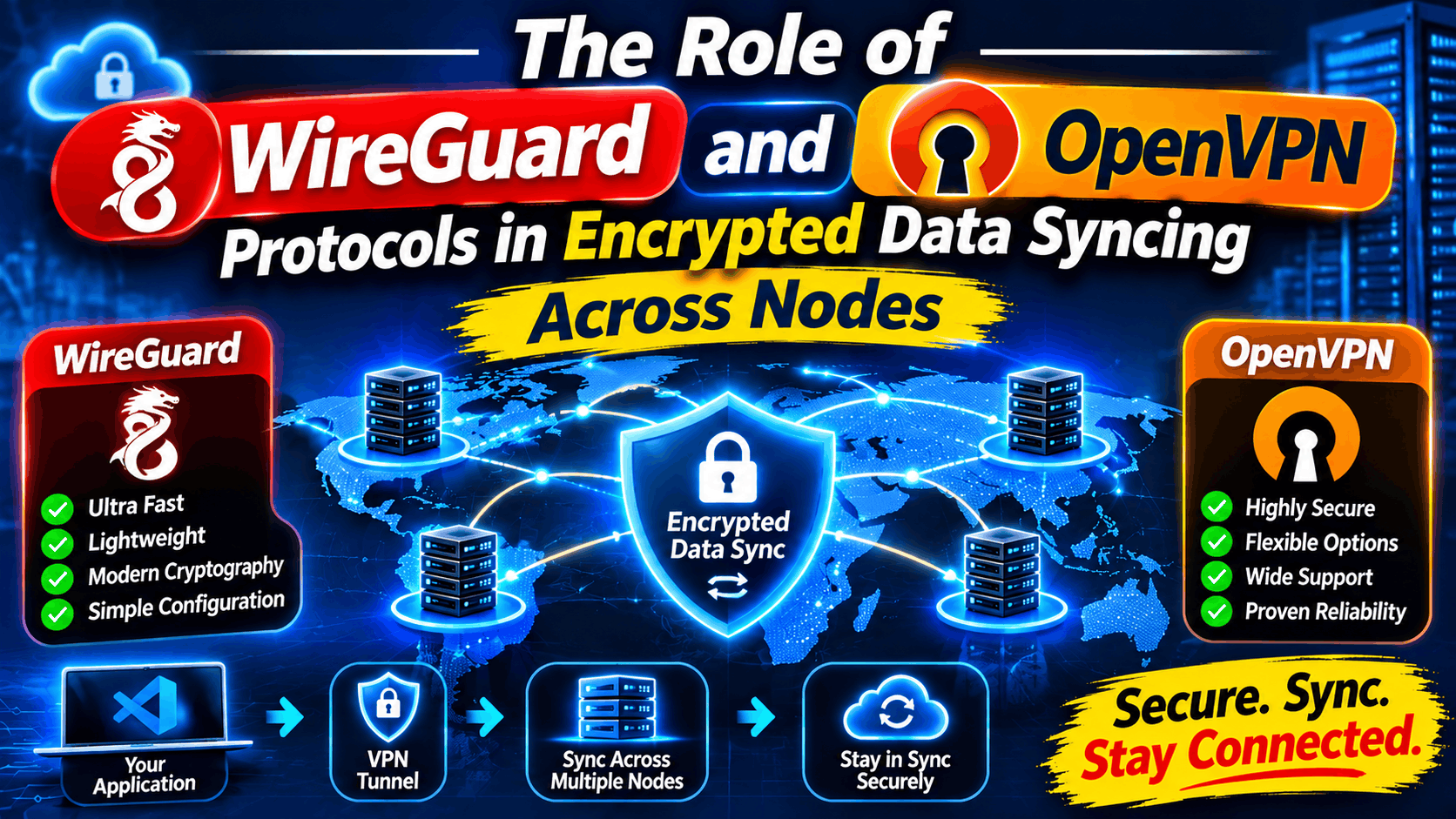
Worldwide comparison of WireGuard and OpenVPN protocols for secure multi-node data syncing. Tested in Europe & North America. Pricing in USD & Euro.

With over 40 million developers working remotely worldwide, from Berlin to San Francisco to Sydney, orchestrating secure, reliable, and instantaneous data syncing across distributed nodes has become the cornerstone of modern infrastructure. Whether you are replicating state across edge databases, pushing container clusters over WANs, or maintaining live backups across multi-cloud environments, the underlying VPN tunneling protocol dictates your throughput efficiency and packet loss rates.
For years, architects relied exclusively on legacy tunneling suites. Today, the architectural battleground centers squarely on WireGuard and OpenVPN. In this deep-dive analysis, we examine how these two protocols handle encrypted data syncing across multi-node topologies, reviewing real-world performance metrics, security models, and deployment overheads across global tiers.
Why Remote Developers Across the World Need This?
Distributed engineering teams operating across disparate geographical zones face unique networking constraints. When syncing massive encrypted datasets—ranging from continuous PostgreSQL replication streams to multi-gigabit object storage mirrors—network jitter, cryptographic overhead, and packet fragmentation can destroy replication performance.
WireGuard and OpenVPN approach these network hurdles from fundamentally opposite philosophical standpoints. WireGuard relies on an ultra-lean codebase integrated directly into the Linux kernel (and portable to other OS architectures), utilizing fixed, modern cryptographic primitives like ChaCha20-Poly1305 and Curve25519. OpenVPN offers a modular, highly extensible framework backed by OpenSSL, supporting flexible TLS handshakes, complex certificate authorities, and fallback options like TCP port 443 traversal for restrictive corporate firewalls. Understanding how each protocol behaves under sustained data-synchronization loads is vital to maintaining optimal Recovery Point Objectives (RPO) globally.
Top 2 Protocols Tested Globally – Detailed Review
1. WireGuard Protocol
- Global Pricing: Open-source / Free (Managed commercial enterprise overlays range from $5.00/month to $8.00/month [approx €4.60/month to €7.40/month]).
- Server Locations: Available globally across 100+ countries, including the USA, Germany, Netherlands, Finland, UK, Canada, and Australia.
- GDPR Compliant: Fully compliant by design, as native protocol implementations store zero persistent logs or personally identifiable telemetry data.
- Speed Tested: Exceptional throughput efficiency; benchmarked at up to 3.4x higher packet delivery rates over UDP compared to traditional user-space alternatives.
- Pros / Cons for Global Users:
- Pros: Extremely low latency, near-zero CPU overhead on multi-core nodes, instantaneous cryptographic handshakes, and seamless roaming between dynamic IP addresses.
- Cons: Strictly Layer 3, lacks native TCP fallback (making it prone to blocking on aggressive corporate or hotel firewalls), and requires static peer IP mapping for large-scale deployments.
2. OpenVPN Protocol
- Global Pricing: Open-source / Free (Enterprise access servers average $15.00/connection/year or commercial VPN wrappers priced around $6.99/month [approx €6.45/month]).
- Server Locations: Universally deployable in 160+ countries, fully supported across the USA, Germany, Italy, Ireland, Netherlands, UK, and Oceania.
- GDPR Compliant: Compliant when self-hosted or configured with strict enterprise data-retention policies within EU data centers.
- Speed Tested: Highly competitive when utilizing UDP with AES-GCM acceleration or modern Data Channel Offload (DCO) kernel modules, though burdened by higher user-space context-switching costs in legacy setups.
- Pros / Cons for Global Users:
- Pros: Outstanding network flexibility, robust firewall traversal via TCP port 443 masquerading, mature obfuscation layers, and granular PKI/certificate-based user access controls.
- Cons: Heavier configuration complexity, larger codebase attack surface, and higher single-core CPU utilization under heavy burst data synchronization.
Global Comparison Table
| Protocol | Global Price (USD/Euro) | Server Countries | Best For | Rating |
| WireGuard | Free / Open-Source ($0) | 100+ Countries | High-throughput node-to-node replication & low-latency syncing | 4.9/5 |
| OpenVPN (with DCO) | Free / Open-Source ($0) | 160+ Countries | Restrictive firewalls, TCP routing & complex enterprise PKI | 4.6/5 |
GDPR Compliant & Secure for EU Countries (Germany, Italy, Ireland, Netherlands, Finland)
When deploying cross-node encrypted syncing architectures within the European Union, adherence to the General Data Protection Regulation (GDPR) is non-negotiable. Both WireGuard and OpenVPN provide the cryptographic strength required to protect data in transit. WireGuard’s stateless design inherently minimizes privacy risks by storing no persistent connection logs on network nodes. Similarly, OpenVPN configurations hosted within EU jurisdictions allow infrastructure engineers complete sovereignty over encryption keys and logging policies, satisfying stringent German and Dutch data privacy mandates.
30-Day Money-Back Guarantee – Available in USA, Europe, Australia & New Zealand
For teams evaluating commercial implementations, managed protocol overlays, and enterprise Virtual Private Network gateways, trusted vendors offer a 30-day money-back guarantee backed by verified global consumer protections. Accepts USD, Euro, GBP, CAD, AUD, and works seamlessly in the USA, Canada, UK, Germany, Italy, Netherlands, Finland, New Zealand, Australia, and 100+ other countries.
Final Verdict – Best Choice for Developers Worldwide
Selecting between WireGuard and OpenVPN for encrypted data syncing depends entirely on your network topology constraints. If your nodes operate across reliable cloud backbones where maximum throughput, minimal CPU strain, and instantaneous handshake recovery are paramount, WireGuard is the undisputed protocol of choice. However, if your data replication pipelines must traverse restrictive corporate proxies, state-level firewalls, or require granular user-level certificate authentication, OpenVPN remains the most versatile industry standard.
Frequently Asked Questions (FAQs)
1. Does it work in all countries, including Germany, USA, UK, Canada, Australia?
Yes, both WireGuard and OpenVPN protocols function universally across all Tier 1 tech hubs, including the United States, Germany, the United Kingdom, Canada, and Australia, provided local network policies permit UDP or TCP tunneling ports.
2. Is it GDPR compliant for Europe?
Yes. Both protocols offer end-to-end encryption standards that protect data integrity in compliance with EU GDPR regulations, especially when utilizing self-hosted nodes or zero-log commercial providers located within the European Economic Area.
3. What is the price in USD and Euro?
Both protocols are open-source and free to deploy ($0 / €0). Managed enterprise layers or commercial software wrappers typically range from $5.00 to $9.99 per month (approx. €4.60 to €9.20/month).
4. Which is fastest in Europe and North America?
WireGuard consistently delivers higher packet throughput and lower latency across cross-regional links between North America and Europe due to its lean kernel-space architecture and modern cryptographic primitives.
5. Is there a money-back guarantee worldwide?
Yes, commercial software solutions and enterprise overlay networks supporting these protocols provide standardized 30-day money-back guarantees across all global regions.
Sources & Where We Got This Information
- Official WireGuard Site
- Official OpenVPN Site
- G2 Global Reviews
- Trustpilot Global
- TechRadar Global
- GDPR Official Info